Showing posts with label Quality Tall Ship Model. Show all posts

Monday, February 6, 2017

The English Ship Fairfax

The English ship Fairfax was originally commissioned in 1650.  By mid 1650 she saw action against French ships in the English Channel.  During 1651 she was Captain Penn’s flagship patrolling the Mediterranean.  By February of 1653 she had returned to England.  During that time she was accidentally set afire and burned to the waterline. 

                                               Abraham Willaerts painting "Action in the first Dutch War"

Immediately following the fire a new ship Fairfax was commissioned and built on the unburnt portion of the original ship.  The new Fairfax was a third rate frigate of the Navy of the Commonwealth of England.  She was re-commissioned as the HMS Fairfax when the English monarchy was restored in 1660.  In 1673 the Fairfax struck a reef off the English coast.  Even though she was re-floated, she was damaged beyond reasonable repair.  She was taken apart and her timbers were re-used in other vessels. 

The Fairfax had a keel length of 120 feet and a beam of 35 feet in width.  She was a full rigged speaker class frigate.  (In the 17th Century the term frigate was used for any warship built for speed and maneuverability.)   Her original complement of 52 guns was increased to 66 guns in 1666 and increased again to 72 guns in 1672.  Similarly her crew of 220 men was increased to 300 in 1666 and to 400 in 1672.

Robert Blake's flagship George at the Battle of Santa Cruz de Tenerife 
She was launched in 1653 and saw her first service in the First Anglo-Dutch War which ended in 1654.  This war was fought entirely at sea over a trade dispute between England and the Netherlands.

During the Anglo- Spanish War (1654-60) the Fairfax was a member of Admiral Robert Blake’s fleet of 23 warships .  During that war she played a key role in the 1657 Battle of Santa Cruz de Tenerife.  This battle resulted in the scuttling of two Spanish Galleons and nine Spanish merchant ships leaving only 5 other Spanish vessels afloat.  Those five ships also surrendered to Blake’s fleet.


                                                                                Admiral Robert Blake

For he last thirteen years the Fairfax saw service as part of Lord Sandwich’s Mediterranean fleet.  Between 1661 and 1662 she patrolled off Tangier and Algiers.  In 1665 she participated in the Battle of the Lowestoft during the Second Anglo-Dutch War.  During that battle the English fleet of 109 ships routed the Dutch fleet of 103 vessels.  The English fleet was significantly more powerful than the Dutch fleet with larger ships, and more guns in number and size.  The Dutch fleet lost nearly 20 vessels while the English only lost one.  The Fairfax saw 8 more years of service with the Royal Navy before the grounding off the English coast ended her career and caused her to be taken apart and reused.


Tall Ship Model of the HMS Fairfax
Ship Models Online offers a 34" Quality Tall Ship Model of the HMS Fairfax .  This is a beautiful, museum quality model.  You'll be proud to display her in your home or office.


Wednesday, January 25, 2017

San Felipe Tall Ship Model Authenticity

The San Felipe is a beautiful and elegant tall ship which is a favorite of ship modeler’s worldwide.  However, historical accuracy of her name and design are questionable.  In fact, she appears to be a cross between the Nuestra Senora de la Concepcion y de las Animas and the Real Felipe.


                                                            1690 oil painting of the Nuestra Senora de la 
                                                             Concepcion y de las Animas by Martin Amigo
Construction of the Nuestra Senora de la Concepcion y de las Animas was begun in 1682, launched in 1688, her masts were installed in 1690.  She worked mainly out of Cadiz but from 1700 to 1702 she sailed to the Caribbean to help with a Scottish conflict.  Later she was badly damaged during the War of the Spanish Succession and was broken up in Cadiz in 1705.  This seems to match the history of the San Felipe associated with today’s model ships.


Illustration of the Real Felipe of unknown origin


The Real Felipe was completed in 1732.  She was reputed to be the largest, most beautiful Spanish ship of her era.  She was severely damaged in the 1744 battle of Toulon and was never fully repaired.  She  was taken apart in 1750.  Unfortunately, no consistent contemporary drawings or illustrations of her exist.  The first illustration of the Real Felipe was made in the late 1700’s by an artist born the year she was broken up. 


                                                               Partial drawing of San Felipe model from 1950

The first illustration of a three deck San Felipe appeared in 1950.  However, this illustration is not consistent with today’s model.  A second illustration by a different artist also appeared in the 1950’s.  This drawing was made by a Spanish ship modeler.  It was originally to represent the Real Felipe 0f 1732.  Due to historical inaccuracies the drawing incorporated some of the features of Spanish ships in the early 1700s. The historical information included on many ship model sites indicates the San Felipe was launched in 1690 and sank in 1705 as a result of a battle with British warships.


Comparison of hull lines of 1950s model San Felipe with  Armada ships of 1712 and 1750

The documentation of the Spanish fleet between 1690 and 1705 does not include the San Felipe.  As shown above, the hull contour of the San Felipe model more closely matches the contours Spanish ship of the line from 1712 than those taken from the 1750 fleet.  This lends credibility to the Nuestra Senora de la Concepcion y de las Animas theory.  However, there is little evidence of three deck Spanish warships being built prior to 1700, and the 1712 drawing is for a two deck ship of the line.  There are similarities with both the Nuestra Senora de la Concepcion y de las Animas and the Real Felipe.  My interpretation is that the ship model San Felipe is actually an interpretation of the Real Felipe interposed with the history of the Nuestra Senora de la Concepcion y de las Animas. 


Modern model of the San Felipe
In any event the San Felipe is a strikingly beautiful ship model.  Check out this Quality Tall Ship Model at San Felipe Ship Model


You can also read a more detailed article about the historic authenticity of the San Felipe at San Felipe Historic Autenticity

Wednesday, December 21, 2016

Capt. James Cook's HMS Endeavor


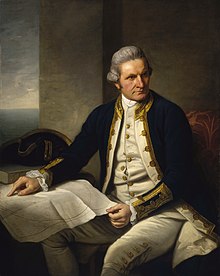
1775 Portrait of James Cook
Captainjamescookportrait.jpgCaptain James Cook of the Royal Navy was a British explorer, cartographer, and navigator.  He commanded three voyages of exploration and circumnavigated the globe twice.  It was on his first voyage that he commanded the research vessel His Majesty's Bark Endeavour on a trip to Australia and New Zealand.

The Endeavor was originally launched in 1764 as the Earl of Pembroake.  The Royal Navy purchased her in 1768 for Cook's expedition and renamed her His Majesty's Bark Endeavour.  A Bark is a class of sailing vessel with two or more square rigged masts and a missen or aftermost mast rigged fore and aft.  Endeavour was 97'8" long, 29'2" wide at the beam, and had 3,221 yards of sail.  The ships complement of 94 included 71 ships company, 12 marines and 11 civilians.  She was armed with ten four pound cannons and twelve swivel guns.  Her landing and other boats included a yawl, a pinnace, a longboat, and two skiffs.

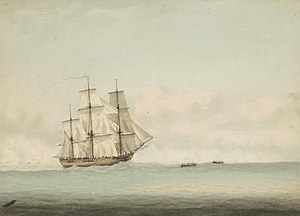
                                                           1798 Painting of HMS Endeavour by Samuel Atkins
A three-masted wooden ship cresting an ocean swell beneath a cloudy sky. Two small boats tow the ship forward.Cook's voyage aboard the Endeavour began in 1768 from Plymouth.  She sailed south along the coast of Africa and crossed the Atlantic to South America at Rio de Janeiro where fresh provisions were brought on board.  After a difficult passage around Cape Horn the scientists collected samples on the south west coast of South America.  The next leg of the trip was to sail west-northwest to Tahiti.  The Endeavour and her crew spent the next three months in Tahiti and accomplished a scientific observation of the transit of Venus across the Sun.  From Tahiti the Endeavour sailed to New Zealand and spent the next six months mapping the coastline.

The voyage then continued to Australia, spending the next four months charting the coast.  She became the first European ship to reach the east coast of Australia in April of 1770.  As she sailed north to chart the Australian coast line she ran aground on the Great Barrier Reef.  The ship was severely damaged.  After much effort and emergency repairs she was floated off the reef and beached for further repairs.  Cook then sailed her to Batavia (modern day Jakarta, Indonesia) where he was able to make more suitable repairs to continue his trip around the globe and back to England.  Though the ship was sound after her repairs, the crew was not.  All but 10 of the people on board the Endeavour contracted malaria and dysentery while in Batavia.  Seven of those people died before she embarked on the return voyage.  Another 26 died on the way to Cape Town.  Before leaving Cape Town the ill were allowed to recover and additional personnel were recruited.  She returned to Dover on 12 July, 1771 after nearly three years at sea.

While Cook was not entirely pleased with the results of this expedition, it was acclaimed by the scientific community and the general public.  He claimed the Pacific islands of Huahine, Bora Bora and Raiatea for Britain and charted the Pacific in much more detail than had been done previously.  Cook was killed during a fight with native Hawaiians on 14 February 1779

After Cooks voyage the Endeavour made several trips to and from the Falkland Islands over the next three years.  Under the name Lord Sandwich she was used as a troop carrier during the American war of Independence.  She was finally scuttled in a blockade off the Rhode Island coast.  Today there are two full sized replicas of the Endeavour, one in Sydney, Australia's Darling Harbour and the second on the River Tees in Stockton-on-Tees, North East England.

    Full sized replica of the HMS Endeavour in Sidney Harbour


                                                                       HMS Endeavour Quality Tall Ship Model
For more information on Captain Cook click here.  Ship Models Online offers a scale model of the HMS Endeavour as well as an open hull scale model of the HMS Endeavour. with a considerable amount of interesting detail.


    HMS Endeavour Open Hull Scale Quality Tall Ship Model